New Insights into Masaya Volcano’s Hidden Magma System
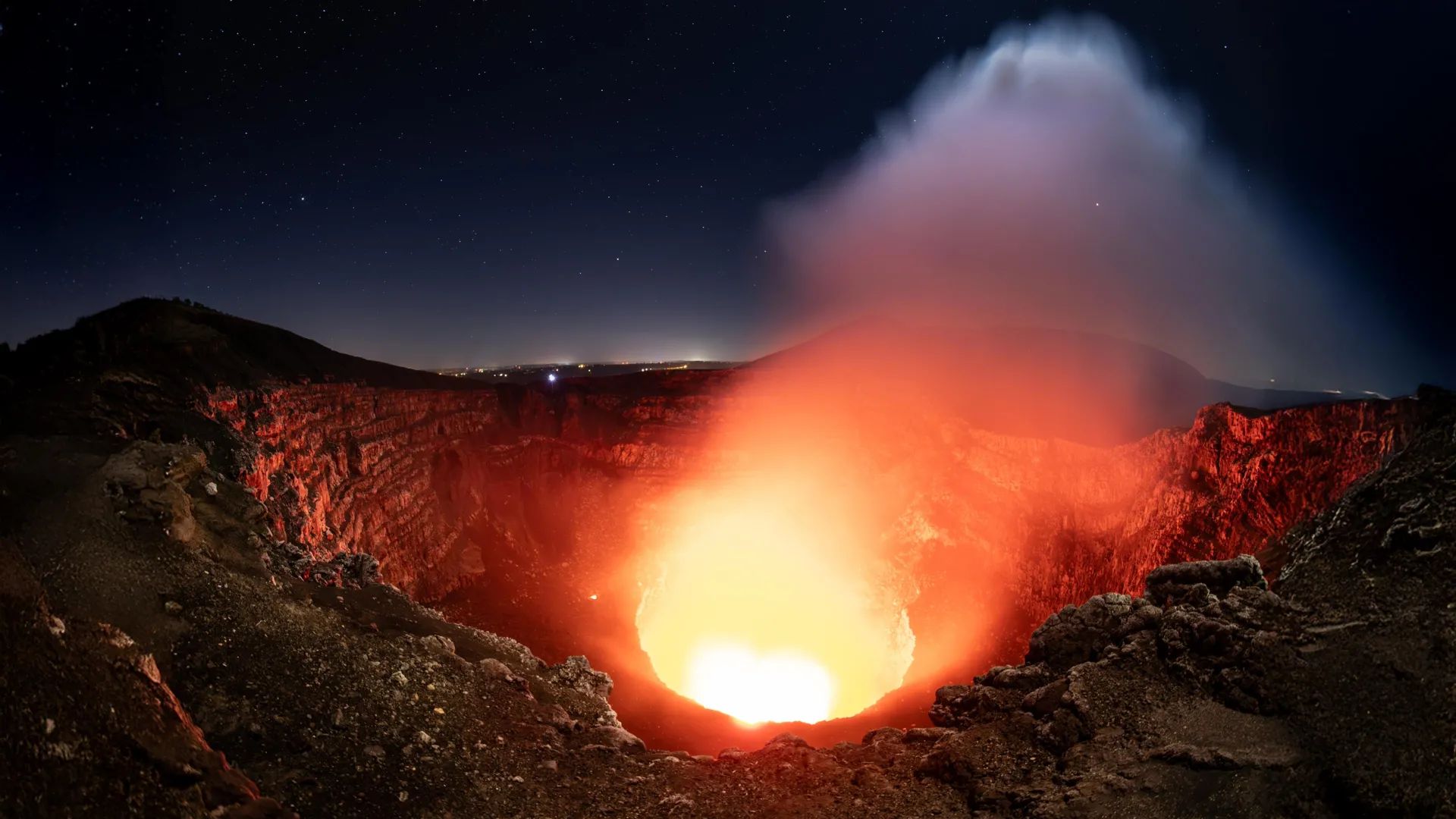
Researchers Uncover Complex Magma System Beneath Masaya Volcano
A recent study led by scientists from Penn State has revealed a sophisticated magma system lurking beneath Nicaragua’s Masaya Volcano, known for its vibrant lava lake. The findings, which highlight two previously unidentified magma sources, have raised critical questions regarding the movement of molten rock beneath the volcano’s surface.
Significance of the Discovery
This discovery is particularly significant as nearly 2 million residents live within a 13-mile radius of the volcano, which is also a popular tourist attraction. Gaining insights into the volcano’s underground activity could enhance scientists’ ability to detect potential eruption warnings, thereby safeguarding nearby communities.
Through six years of satellite observations, researchers monitored subtle ground movements around Masaya. They observed an initial sinking of one section of the volcano, followed by a subsequent rise, possibly indicating the influx of fresh magma into a deep reservoir. In contrast, the area surrounding the active Santiago crater and its lava lake continued to sink, implying a different behavior in a shallower magma reservoir.
“These observations help scientists better understand how magma moves beneath Masaya and may improve monitoring and eruption forecasting in the future,” stated lead author Lizzie Johnson, a recent geosciences graduate from Penn State.
Monitoring Masaya Volcano
Masaya, located near Managua, the capital of Nicaragua, is a volcano characterized by its intricate geological features, including multiple overlapping craters and calderas. These calderas form when the ground collapses after magma is expelled from an underground chamber.
Despite extensive research on Masaya, the dynamics of magma movement within its underground reservoirs remain poorly understood. The changing nature of these systems complicates the task of accurately assessing the volcanic activity beneath the surface.
“Understanding Masaya’s volcanic activity and associated hazards is crucial, as around 2 million people reside nearby, and the caldera serves as a national park and tourist destination,” Johnson emphasized. “While the last major lava flow occurred in 1772, the volcano’s continuous degassing can produce hazardous levels of sulfur dioxide gas.”
Sulfur dioxide, a volcanic gas released when magma approaches the surface, poses health risks. Elevated concentrations can create dangerous conditions for both visitors and local residents, even in the absence of a significant eruption.
Young Cheol Kim, who recently completed his doctorate in geosciences at Penn State, stressed the importance of continuous monitoring to differentiate between normal volcanic activity and potential hazards.
“Continuous monitoring allows us to understand baseline activity and identify changes that may indicate increased volcanic risks,” he noted.
Satellite Technology Unveils Hidden Movements
To assess Masaya’s underground dynamics, researchers utilized data from the Sentinel-1 satellite, which captures images of the volcano approximately every 12 days. They employed a technique known as interferometric synthetic aperture radar (InSAR), which detects minute changes in the Earth’s surface elevation.
This method combines two vital capabilities: synthetic aperture radar transmits microwave signals to the Earth’s surface, allowing for measurements even through cloud cover, while interferometry analyzes the returning radar signals to reveal distance changes between the satellite and the ground.
This capability is particularly beneficial in tropical regions where cloud cover can hinder conventional satellite imaging.
“Cloud penetration is crucial for volcano monitoring because many, including Masaya, are located in tropical areas with frequent cloudiness,” Kim explained. “By analyzing satellite images over several years, we can observe how the distance between the satellite and the ground changes, indicating areas of uplift or subsidence.”
Distinct Magma Reservoirs and Their Behavior
The satellite data revealed a fascinating trend from 2018 to 2024. Initially, the ground within Masaya’s caldera experienced gradual subsidence, followed by a subsequent uplift. Scientists interpret this transition as indicative of changes in the underground magma storage.
When magma drains from a reservoir, the ground above can sink, while an influx of magma may cause the surface to rise. Surprisingly, the area surrounding the Santiago crater exhibited continuous subsidence throughout the study, diverging from the broader caldera’s uplift pattern.
“Subsidence suggests magma is draining from the volcano, while uplift indicates new magma influx,” Johnson explained. “The independent deflation around the Santiago crater suggests a more complex plumbing system, possibly indicating a decrease in magma in a shallower reservoir.”
These observations indicate that Masaya may house at least two distinct magma storage areas, each undergoing different changes. A deeper source may be supplying magma to the main reservoir, while the shallower reservoir near Santiago crater could be losing magma, explaining the contrasting movements within the volcano.
Implications for Future Eruptions
Understanding these underground movements is vital, as ground changes can offer insights into magma accumulation, movement, and potential surface eruptions. The researchers clarified that their findings do not indicate any immediate threats to the surrounding communities. However, recognizing the volcano’s normal behavior and its magma supply system will aid in identifying unusual changes in the future.
Ongoing satellite monitoring, coupled with advanced computer models, could enhance scientists’ comprehension of the connections between underground magma reservoirs and surface volcanic activity.
“Long-term geodetic studies and modeling will deepen our understanding and enable effective hazard monitoring and mitigation at Masaya and similar volcanoes with lava lakes,” Johnson noted.
From Student Research to Volcano Science
Johnson became involved in this research after attending a presentation by Christelle Wauthier, a Penn State professor of geosciences. She conducted this research as part of her Schreyer’s Honors College thesis, collaborating with graduate researchers, including Kim, to analyze satellite data and hone her scientific skills.
“Participating in a research group was invaluable for me, as I had no prior experience in research. Engaging in group meetings and learning coding has been beneficial as I pursue my Ph.D. in Earth sciences at the University of Hawaii at Manoa, where I will study Kilauea volcano using seismic waves,” Johnson shared.
This research received funding from the U.S. National Science Foundation and computational resources from Penn State’s Institute for Computational and Data Sciences. The authors take full responsibility for the findings and conclusions, which do not necessarily reflect the views of the funding organizations.
Materials provided by Penn State University. Original content authored by Emma Stefanacci. Note: Content may be edited for style and length.
Penn State University. “New Insights into Masaya Volcano’s Hidden Magma System.” ScienceDaily. ScienceDaily, 19 October 2026. www.sciencedaily.com/releases/2026/10/261018205039.htm.
Source Reference (sciencedaily.com): Something strange is happening beneath a volcano near 2 million people